David Hockney (born 9 July 1937) was an English painter, draughtsman,
printmaker, stage designer and photographer.
In this review I am going to focus on his photography. In the early
1980’s Hockney started to produce photo collages calling them “Joiners”. The
reason for this was he did not like the way other photographers took
photographs , using cameras with wide-angle lenses . He didn’t
like these photographs because he thought they looked somewhat distorted, frozen
and didn’t have life the way a drawing and painting did. Using a Polaroid
camera he took lots of individual photographs of the subject while it was
moving around. He done this so it would
show the subject from the camera’s perspective as the subject moved around the
camera. He arranged them, sticking them on card, thinking about the composition,
line and form that drawings and paintings had. He first produced them
from Polaroid prints and then to 35mm commercially processed colour prints. These
photo collages were like Cubist compositions made from the photos. This was something that Hockney aimed
for. He also created portraits consisting
of many photographic details of the sitter. In his later work he started to move
around the subject instead of the subject moving around him. I like these photo
collages because he takes them all from different view points, so I think you
get to see a ‘fuller’ picture.
I would like to try to include some images using this technique in my
final 8 images.
Below are a few of Hockney’s
images.
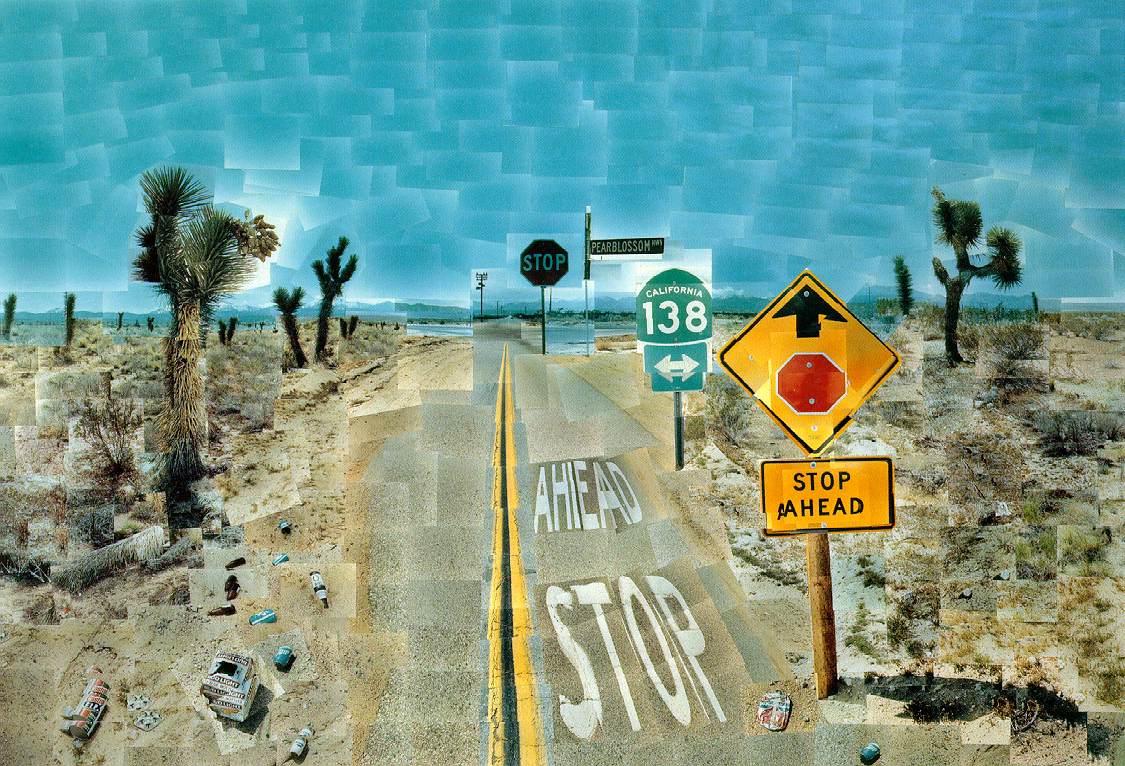
Pearblossom Highway, 11th-18th April 1986, photographic
collage, 77x112 1/2 in.
This
here is Pearblossom Highway. I like this
because of the view, the American road way, the signs, trees, the rubbish on
the ground, everything. Apparently when he did this he took roughly 800 hundred photographs. I like the composition, and the fact that it is clearly a sunny, hot day. You can see everything clearly because of the technique he used. When I did a bit of research on this, it is clear that this was created during the time when HE was moving around the subject, rather than the SUBJECT moving around him. This is what gives this image it's perspective. Everything in the image was taken when he stood very close to it, and then arranged it to make it look like you were looking at it from the one viewpoint. This makes you feel involved in the image. In particular I do like colour of the sky and research suggests that he aimed to create a specific shade of blue, similar to paintings.

Robert Littman Floating in My Pool, Oct. 1982 photographic collage, 22
1/2 x 30 in.
I presume
this is a photograph of Robert Littman in his pool as this is what the image is
called. I like how he had done the
composition for it, where he has taken the photograph of the man’s body and the
fact that it is in a pool in a hot country … it makes me feel like I want to go
on holiday ! The image is calm and
peaceful, and I like the shade of blue of the pool.

Mother I, Yorkshire Moors, August 1985 Photographic collage
This is one of his many portraits of his mother. When I
first saw his work it was a portrait of his mother and I like the way he did
the photographs so that is what has inspired me to do this review. When looking
at this photograph in particular at
first I thought it looked quite unappealing, because of the closeness of her
head, and the fact that it is only
her head. When you look more closely, however,
you get to see her face from different viewpoints, and I find that I do like it.
Here is some more of his work I like


