Wednesday, 28 May 2014

Man Ray


Man Ray (born, August 27, 1890 – November 18, 1976 as Emmanuel Radnitzky) was an American modernist artist who spent most of his career in Paris, France. He was a significant contributor to the Dada and Surrealist movements. As well as being a photographer he was a painter, a writer, a film maker and sculpter.

Man Ray himself said photography wasn’t about using or developing a technique for the sake of doing so, but because he felt that doing so genuinely creating interesting images. “I have always preferred inspiration to information”  (Man Ray)

He tried to create surrealist images using solarisation, cropping and various development techniques to create a surreal effect in his photos. Some of these images become known as Rayogrammes, pictures produced on photographic paper without using a camera. This was achieved by placing the subject directly on top of photographic paper and then exposing the whole thing to light. The resulting image is effectively the shadow of the subject.

I like Man Ray’s work cause I can appreciate the skill required to create them, although I don’t approve of the way he has used women in photography.


This here is one of man rays Rayogrammes.   It could be these are tools that he used on a day to day basis in the dark room, however I am also aware that he frequently used objects familiar to him related to his parents occupation as a tailor. The technique used is explained above.


This here is called Les Larmes (Glass tears) (1932). I recognize this image because I have seen it many a times. When I look at this, this actually looks like a film still of a actress of the 1930's but from my research on this image it is actual a mannequin that he has used and  demonstrates his interest in cinematic narrative. 


 This is an image of Ray's assistant Lee Miller. I like this image because of the technique that he has used, it is solarisation which renders part of a photographic image negative and part positive by exposing a print or negative to a flash of light during development. Man Ray and his assistant stumbles on this technique by accident but developed it and used it to great effect as this picture demonstrates. I have heard of solarisation before, in films and pictures and I like it because I think it produces a nice image.


Thursday, 15 May 2014

Imogen Cunningham


Imogen Cunningham (April 12, 1883 – June 24, 1976) was an American photographer , which she was known for taken pictures of nudes,  botanical and industrial landscapes.  Imogen studied chemistry at the University of Washington in Seattle and after being advised by her professor that she should get a scientific background if she wanted to be a photographer. During this time she worked as a secretary producing slides for the botanists at university. It may be this that got her into taking photos of plants.  After graduation Imogen worked in the Seattle portrait studio of Edward S. Curtis, a photographer. Here she learned the techniques of platinum printing, which gave her a greater tonal range in her black and white photography. Her first photographs were of allegorical studies, which she made with artist friends. Characteristics of the photographs were the soft focus, or blurred imagery.  In the 1920’s Cunningham refined her style, taking a greater interest in pattern and detail and becoming increasingly interested in botanical photography, flowers and nudes.  In the 1940s, Cunningham turned to documentary street photography. Cunningham died in 1976 at the age of 93.          
                                                                                                                                                   

                                                                   Nude 1932
When I first started this photography unit, we were shown this in a power point. We were told about composition and I couldn’t understand it when I looked at this one . I was curious about the composition of this one because it was right in the center and from I can remember  from what I was told , the photographer has not followed the traditional rules of composition, such as the rule of thirds, in this image. When i look at this my eye follows the body round.  


Hands and Aloe Plicatilis, 1960
In this photograph here she has used a technique called Double Exposure which combines two different images into a single image.  This is achieved by taking one photograph, and not winding the film on, and then taking another photograph on ‘top of’ the same bit of film.   I think she has used this technique to bring together 2 things which she recognises are similar in shape and form … the human hand and the flowers.  From my research I know that she became interested in taking photos of hands and feet, and this image may be part of that interest.
 
Agave Design 1, 1920s
This is one of her botanical photos, I like this because the way it is positioned and from what I was studying of using shapes in her images, I could see shapes in this – triangles, straight edges creating sharp points. When I started this unit in photography, I couldn’t understand composition and shapes in photographs, however after doing it for a while I can now understand it better and I can see it better in photographs. I perhaps do not fully understand composition but I am starting to recognize well composed images.


Herb Ritts


Herbert "Herb" Ritts (August 13, 1952 – December 26, 2002) was an American fashion and portrait photographer who concentrated on black-and-white photography, often in the style of classical Greek sculpture.
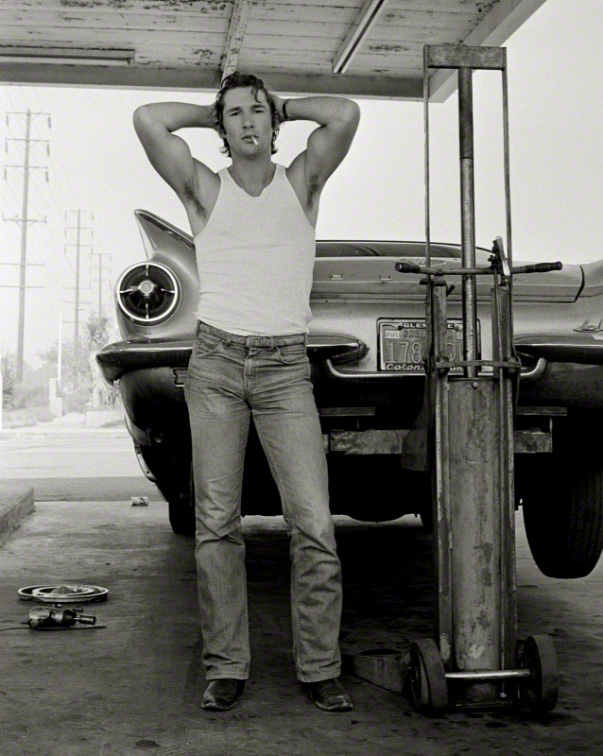
Growing up in California, Ritts was influenced by the scenery and the weather in the state, and this is evident in his photography.  He developed a fondness and an affinity for the wide open spaces the sunlight and the warmth.  An example of this can be seen in his famous photo of Richard Gere.  
He has worked for the likes of fashion magazines such as Harper's Bazaar, Vogue and Elle, as well as doing album covers, music videos and many portraits of famous stars including Richard Gere, Jack Nicholson, Madonna and Cindy Crawford.
In his photography, Ritts uses light and shade and the human form to create interesting images, often using lines and curves to guide the eye into the image.  In some of his images he has the background blurred so that he makes you look at the subject rather than the background.  This may relate to his affinity to wide open spaces. 


In this image, we can see the use of wide open spaces and light.  We can see the light at the top which suggests it is a wide open space, and the darkness of the shadows below the car.  After learning about this, I now like this image, whereas before it done nothing for me !


As this is an album cover image for Madonna’s True Blue album, I already liked this picture as I had seen it before.  When looking at this photograph I noticed that it is blurred in the background, so that it makes the subject come forward.  I think this is created by using a short depth of field.  This is related to aperture. 
Also, the way he has placed the lights, I presume he has put a light right above her as it looks like there is a light shining down on her face … you can see this because of the shadows under her chin and ear.  The way he has made Madonna stand may be influenced by his interest in Greek sculpture, and by throwing her head back, had made her chin and neck more noticeable, which I think makes the picture much more interesting.  In this image, Ritt’s use of line and form has drawn my eye into the image.

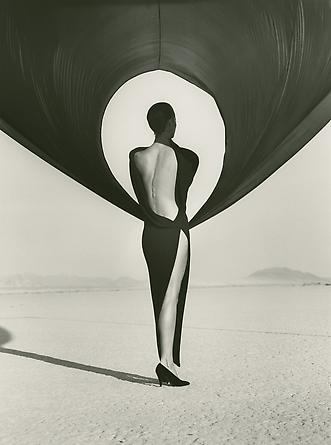
  This photo was taken outside, reflecting his interest in wide open space. I like the strong contrast of the image, making the subject stand out against the negative space.  In particular I like the use of form to create the circle around the subject.